Oral micronized progesterone produced a mixed result in a Canadian trial of 189 perimenopausal women: the main diary-based measure of hot flashes and night sweats did not show statistically significant superiority over placebo, while several end-of-treatment assessments favored progesterone. That distinction is central. The study provides reasons to investigate perceived sleep and night-sweat improvements, but it was not a positive trial on its prespecified primary endpoint.
The analysis below uses the full perimenopause research article, including its tables and funding disclosures, alongside the indexed primary report abstract for a separate postmenopause trial and current official labeling material. Separate protocols and supplementary files were not independently examined. For Capsule Questions, the practical scientific issue is specific: what did this oral capsule study measure, how precise were its findings, and where do sedation, formulation, and incomplete evidence change the interpretation?
In this article
Study facts at a glance
Population: 189 women aged 35–58, averaging 49.9 years, were randomized; 93 were assigned progesterone and 96 placebo. Source 1
Treatment duration: One untreated baseline month preceded three treatment months—not four months of drug exposure. Source 1
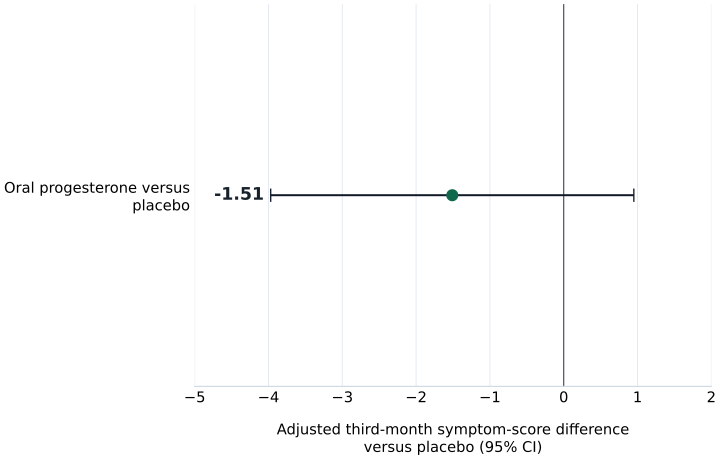
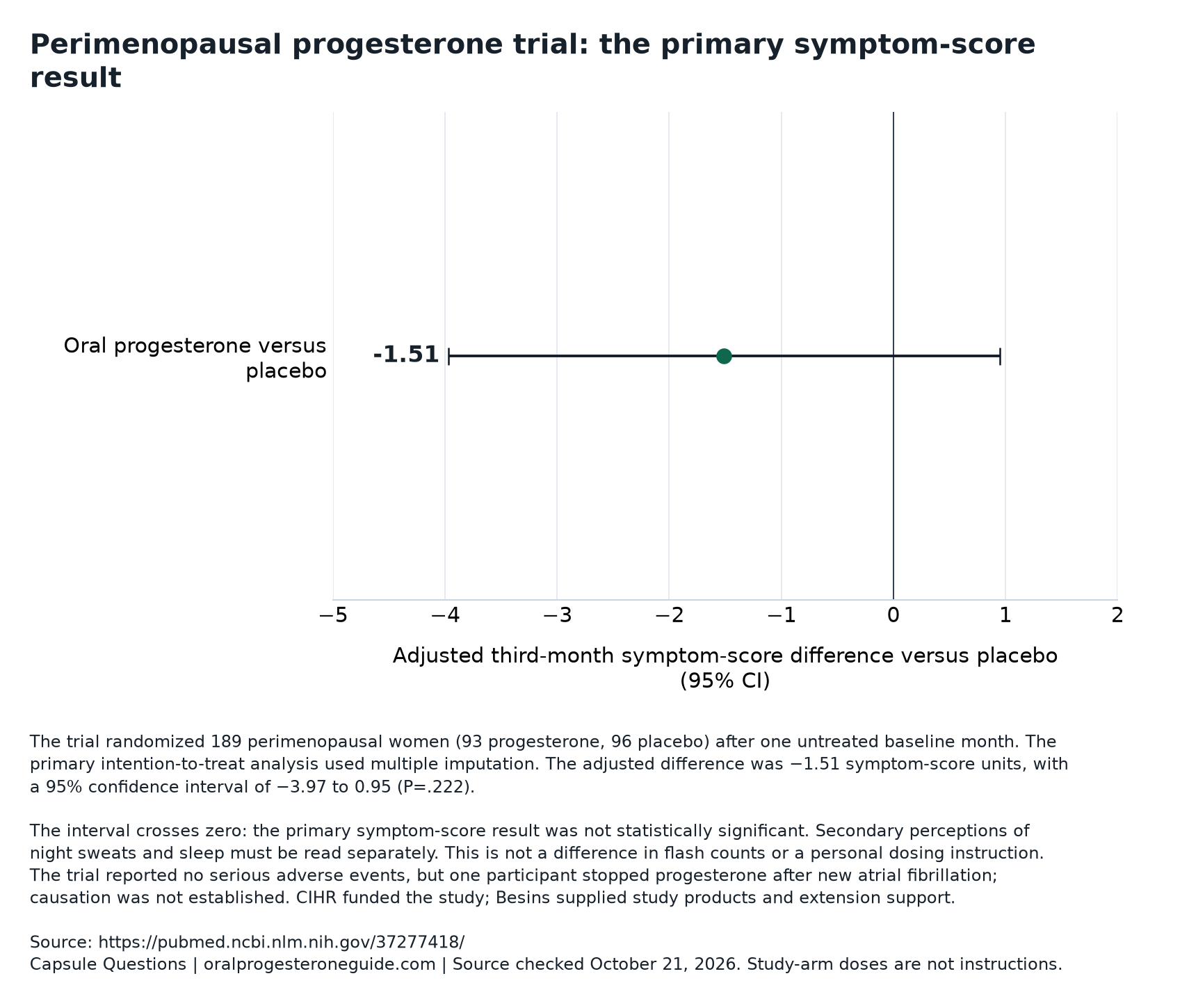
Primary result: The adjusted third-month VMS-score difference was −1.51 points (95% CI −3.97 to 0.95; P=0.222), not statistically significant. Source 1
Sleep findings: Retrospective perceived sleep quality favored progesterone, but third-month calendar-recorded sleep problems did not differ between groups. Source 1
Safety findings: Investigators reported no serious adverse events, but more mild-to-moderate side-effect reports occurred with progesterone; one participant stopped after new-onset atrial fibrillation. Source 1
Who entered the trial—and who did not
Participants had menstruated within the preceding year and reported bothersome vasomotor symptoms, or VMS: hot flashes and night sweats. Eligibility could be met through qualifying symptom frequency or night-sweat awakenings at least twice weekly. In fact, 186 of 189 randomized participants met the night-sweat awakening criterion. This was therefore a particularly relevant population for nighttime symptoms, rather than a general sample of everyone approaching menopause.
Baseline table data classified 63 women as early perimenopausal and 126 as late perimenopausal. Most were White, 57.1% had a university degree, and average body mass index was 26.7. Exclusions included hysterectomy or bilateral ovary removal, recent menopausal hormone therapy or combined hormonal contraception, and pregnancy plans or breastfeeding. Depression screening excluded some women needing clinical follow-up or treatment. Fewer than 10 participants could continue specified stable hormonal treatments, so describing the entire sample as hormone-free would be inaccurate. These eligibility boundaries matter when considering whose symptoms the findings represent.
Read the underlying chart data: download CSV or download the source-labeled chart.
Three treatment months inside a four-month study
The University of British Columbia managed this single-center, Canada-wide study during 2012–2017. After an untreated baseline month, participants received either oral micronized progesterone, 300 mg at bedtime as three 100-mg capsules, or identical placebo for three months. Those quantities identify the historical research arms, not a treatment recommendation. Randomization used blocks stratified by early or late perimenopause; an independent statistician generated assignments, and the pharmacist allocated treatment through a protected website.
Both participants and investigators were blinded during treatment. Although recruitment began locally, protocol changes enabled remote participation, which accounted for 93.1% of randomized women. Monthly contacts assessed well-being, adherence, and adverse events. Capsule counts and calendar records indicated adherence of 91.4% with progesterone and 84.4% with placebo. Remote participation broadened geographic reach without turning this into a multicenter trial or establishing that any commercial remote-care service reproduces its procedures.
What the symptom score actually counted
Participants recorded daytime hot-flash and nighttime sweat numbers and intensity daily. The VMS score combined daytime frequency multiplied by intensity with nighttime frequency multiplied by intensity, then summarized daily averages. At baseline, mean score was 12.2, mean frequency was 4.9 episodes per day, and mean intensity was 2.3. These are different measurements: a score of 12.2 does not mean 12.2 episodes.
As an illustrative calculation—not participant data—three daytime episodes rated 2 and two nighttime episodes rated 3 would yield a score of 12: six daytime points plus six nighttime points. Removing one nighttime episode would lower the score by three points, while lowering each daytime intensity rating by one would also lower it by three. Thus, the same score change can represent different lived experiences. A combined score is useful for summarizing burden, but it cannot by itself identify whether frequency, severity, daytime symptoms, or nighttime symptoms drove a change.
The primary estimate favored progesterone but remained inconclusive
The primary endpoint was the third-treatment-month VMS score, adjusted for baseline score and perimenopausal phase. The adjusted difference was −1.51 points, with a 95% confidence interval from −3.97 to 0.95 and P=0.222. Negative values favor progesterone. The interval includes no difference, a potentially meaningful benefit, and a small difference favoring placebo. It therefore supports neither a definitive benefit nor a conclusion that progesterone has no effect.
Researchers used a negative-binomial model because scores were skewed and unusually variable. Its ratio of model means was 0.79 (95% CI 0.54–1.15). This is not a patient risk ratio: it does not mean 21% fewer women had symptoms or a 21% greater probability of relief. The authors converted the model result into an adjusted score difference for easier interpretation. Unadjusted third-month means, 5.5 with progesterone and 7.1 with placebo, give a raw gap of 1.6 points, not the exact adjusted estimate.
Third-month diary outcomes: negative adjusted differences favor progesterone.
| Outcome | Adjusted difference, 95% CI | Interpretation |
|---|---|---|
| Combined VMS score | −1.51 points; −3.97 to 0.95 | Primary endpoint; not statistically significant |
| VMS frequency | −0.60 episodes/day; −1.50 to 0.29 | No established between-group frequency benefit |
| VMS intensity | −0.17 scale points; −0.56 to 0.22 | No established between-group intensity benefit |
Why the uncertainty was wider than planned
The original sample calculation sought a three-point score difference, using an assumed standard deviation of 6.2 and allowing for discontinuation. A planned blinded reassessment found greater residual variability, with an adjusted standard deviation of 8.0. Researchers increased the target to 228 completing participants, but funding ended after 189 had been randomized and 176 completed. Enrollment did not meet the revised target.
The three-point threshold helps explain the authors’ interpretation. A difference of −3 lies inside the primary confidence interval, so a benefit of that size was not excluded. But compatibility is not demonstration: the same interval also includes zero. Symptoms fell in both groups, and 49 screen-qualified women had already become ineligible because baseline symptoms were insufficient. That pattern illustrates fluctuation before treatment even began. It helps explain why improvement within the active arm alone cannot identify a drug effect; the placebo comparison, not the before-and-after change, addresses that question.
Missing diaries were modeled, not simply ignored
The primary analysis followed intention-to-treat principles, retaining the randomized treatment framework and addressing missing observations through 100 multiple imputations. This procedure creates multiple plausible completed datasets using observed information, rather than treating every missing value as zero or removing everyone with incomplete records. The imputation model included symptom measures, treatment assignment, perimenopausal phase, demographic variables, and questionnaire information.
A separate sensitivity analysis included 176 women with at least seven calendar days in both baseline and the third treatment month. Its adjusted score difference was −1.58 points (95% CI −4.00 to 0.84; P=0.191), closely resembling the primary estimate. Agreement makes it less likely that the headline conclusion arose solely from that particular missing-data approach. It does not establish that unobserved symptoms were fully recoverable or eliminate assumptions about why observations were missing. Neither analysis crossed into a statistically significant primary benefit.
Perceived sleep improvement answered a different question
On the final treatment day, a retrospective questionnaire asked women how symptoms had changed. Perceived overall night sweats favored progesterone (P=0.023), as did perceived sleep quality (P=0.005). These findings are relevant because relief as experienced by participants matters. However, calendar-recorded sleep problems and anxiety did not differ between groups in month three. Retrospective overall improvement and repeated daily ratings are not interchangeable endpoints.
The report does not provide a straightforward numerical sleep-benefit estimate with a confidence interval in its text or outcome table; the perceived-change distributions appear graphically. A small P-value cannot fill that magnitude gap. The study also cannot determine whether better perceived sleep reflected fewer sweats, less awakening or awareness, another sleep effect, or a combination. The drowsiness and daily-safety guide addresses a related distinction: feeling sedated is not proof of restorative sleep. These secondary results justify further testing, not relabeling the primary trial as successful.
Daily interference improved; safety findings still require specifics
Perimenopause-related interference with usual activities favored progesterone by an adjusted −6.65 questionnaire points (95% CI −12.11 to −1.18; P=0.017). Depression scores did not show a between-group difference: −0.40 points (95% CI −1.57 to 0.77). That result concerns a screened population over three treatment months, not evidence that progesterone treats depression. The publication carries a correction concerning questionnaire group values in Table 2, another reason to distinguish adjusted comparisons from descriptive table entries.
Investigators reported no serious adverse events, but mild-to-moderate side-effect reports totaled 22 with progesterone versus eight with placebo. Nausea or gastrointestinal problems numbered eight versus one; dizziness occurred in one participant per group. A physician required one progesterone participant to discontinue after new-onset atrial fibrillation. The report does not establish that progesterone caused it, but omitting the event would misrepresent the safety record. Some printed adverse-event percentages have denominator inconsistencies, so exact counts are more dependable here. Three months in 189 participants cannot resolve uncommon or long-latency harms.
The postmenopause trial is supporting context, not a replacement
A separate randomized trial studied healthy postmenopausal women aged 44–62, one to 10 years after final menstruation. Its indexed abstract reports a statistically significant adjusted VMS-score advantage of −4.3 points (95% CI −6.6 to −1.9). It used the same daily oral research dose, but the population was selected for favorable cardiovascular screening, and analysis included 114 of 133 randomized women with baseline and treatment symptom data. Those features differ from the perimenopause study’s population and imputed intention-to-treat analysis.
The postmenopausal hot-flash trial analysis examines that evidence separately. A significant result in one trial and a nonsignificant result in another do not themselves prove that menopausal stage changes treatment response; demonstrating that would require an appropriate comparison. Nor should raw within-arm reductions replace adjusted between-group estimates. The postmenopause abstract reports 12 adverse-event discontinuations overall—eight on progesterone and four on placebo—with no serious cases. It does not identify funding, so the perimenopause study’s funding disclosures cannot be transferred to it.
Two oral progesterone trials studied different populations and analysis sets.
| Feature | Perimenopause trial | Postmenopause trial |
|---|---|---|
| Randomized population | 189; menstruation within previous year | 133; 1–10 years after final menstruation |
| Observation and treatment | 1 baseline month, then 3 treatment months | 4-week run-in, then 12 treatment weeks |
| Primary adjusted score difference | −1.51; 95% CI −3.97 to 0.95 | −4.3; 95% CI −6.6 to −1.9 |
| Primary analysis information | Intention-to-treat with multiple imputation | 114 with run-in and treatment VMS data |
Capsule labeling and funding define the remaining boundaries
Current US Prometrium labeling lists prevention of endometrial hyperplasia in postmenopausal women with a uterus receiving conjugated estrogen tablets, and treatment of secondary amenorrhea—not progesterone-alone hot flashes or insomnia. The prescribing-purpose guide helps separate those questions. The label warns about dizziness and drowsiness and retains important contraindications. US Prometrium contains peanut oil; historical Canadian formulation comments do not override the exact product record. The capsule-ingredient guide explains why formulation identity matters. FDA’s February 2026 labeling announcement did not erase all hormone-therapy risks or create a new symptom indication.
The perimenopause trial received Canadian Institutes of Health Research funding. Besins Healthcare International supplied Prometrium and placebo and made a university donation supporting an additional recruitment year; authors declared no competing interests. Editorial interpretation: a care agreement should identify the actual product, intended outcome, monitoring responsibilities, and documentary terms rather than promise this trial’s results. The follow-up guide, CoreAge Rx review, and Winona review offer places to check those questions, not evidence of product availability or outcomes. Findings do not automatically transfer to providers, compounded capsules, other routes, or other formulations.
Questions about the evidence
Did this trial prove progesterone reduces perimenopausal hot flashes?
No. Its prespecified third-month combined symptom score did not show statistically significant superiority over placebo. The estimate favored progesterone, but the confidence interval included both no difference and a potentially meaningful benefit. This is an inconclusive efficacy result, not proof of ineffectiveness and not a positive primary trial.
Why take the sleep findings seriously if the primary endpoint was inconclusive?
They capture a participant-important experience that a combined symptom score may not fully describe. But the retrospective perceived improvement differed from the daily sleep-problem result, and a clear sleep-effect magnitude with confidence limits was not reported in the text or main table. Confirmation should measure both perceived benefit and repeated sleep outcomes.
Does the study establish an insomnia treatment?
No. It enrolled women for perimenopausal vasomotor symptoms, not a defined insomnia-treatment population, and did not establish efficacy for a diagnosed sleep disorder. Prometrium’s current US indications do not include insomnia. Its drowsiness warning is a safety consideration, not independent evidence of restorative sleep.
Does no serious adverse event mean no important safety concern?
No. The authors reported no serious adverse events, but side-effect reports were numerically higher with progesterone, and one participant discontinued after new-onset atrial fibrillation. Causation was not established. The short follow-up and sample size also leave uncommon and longer-term risks unresolved.
What would a more decisive follow-up trial need?
It would need enough participants for the observed symptom variability, a clearly prioritized primary endpoint, transparent missing-data analyses, and numerical estimates for sleep and night-sweat outcomes. Longer observation would improve safety assessment. Measuring nighttime symptoms and sleep separately could help clarify whether perceived relief reflects fewer sweats, different awakening patterns, or both.
What this evidence supports
Three months of oral micronized progesterone did not establish superiority on the primary perimenopausal VMS score. Secondary perceived night-sweat, sleep, and daily-interference findings provide a credible research signal, but they do not resolve the main estimate’s uncertainty. Capsule-specific labeling and actual adverse-event counts remain essential to interpreting that signal.
Research access and limitations
The perimenopause full article and main tables were available; separate protocols and supplementary files were not independently examined. The postmenopause comparison relies on its indexed primary abstract. Numerical sleep-effect magnitude, longer-term safety, and applicability to broader populations remain unresolved.
Sources for this article
Source type matters. A provider page describes an offer; an exact product label describes that medicine.
- Oral micronized progesterone for perimenopausal night sweats and hot flushes a Phase III Canada-wide randomized placebo-controlled 4 month trial.Indexed primary study abstract and full research article · Checked 2026-10-21
- DailyMed — Prometrium progesterone capsule, Acertis Pharmaceuticals LLCCurrent exact oral Prometrium DailyMed label, updated July 23, 2026; patient leaflet revision February 2026. Does not establish provider supply. · Checked 2026-10-21
- Oral micronized progesterone for vasomotor symptoms--a placebo-controlled randomized trial in healthy postmenopausal women.Indexed primary study abstract · Checked 2026-10-21
- FDA: February 12, 2026 approval of menopausal hormone therapy labeling changesFederal regulator announcement · Checked 2026-10-21